
When a Glacier Collapses, the Impact Travels Far Beyond the Mountains
A devastating flash flood near the Nepal–Tibet border has turned a natural disaster into an international humanitarian crisis — and a reminder of how quickly our changing climate can reshape the world around us.
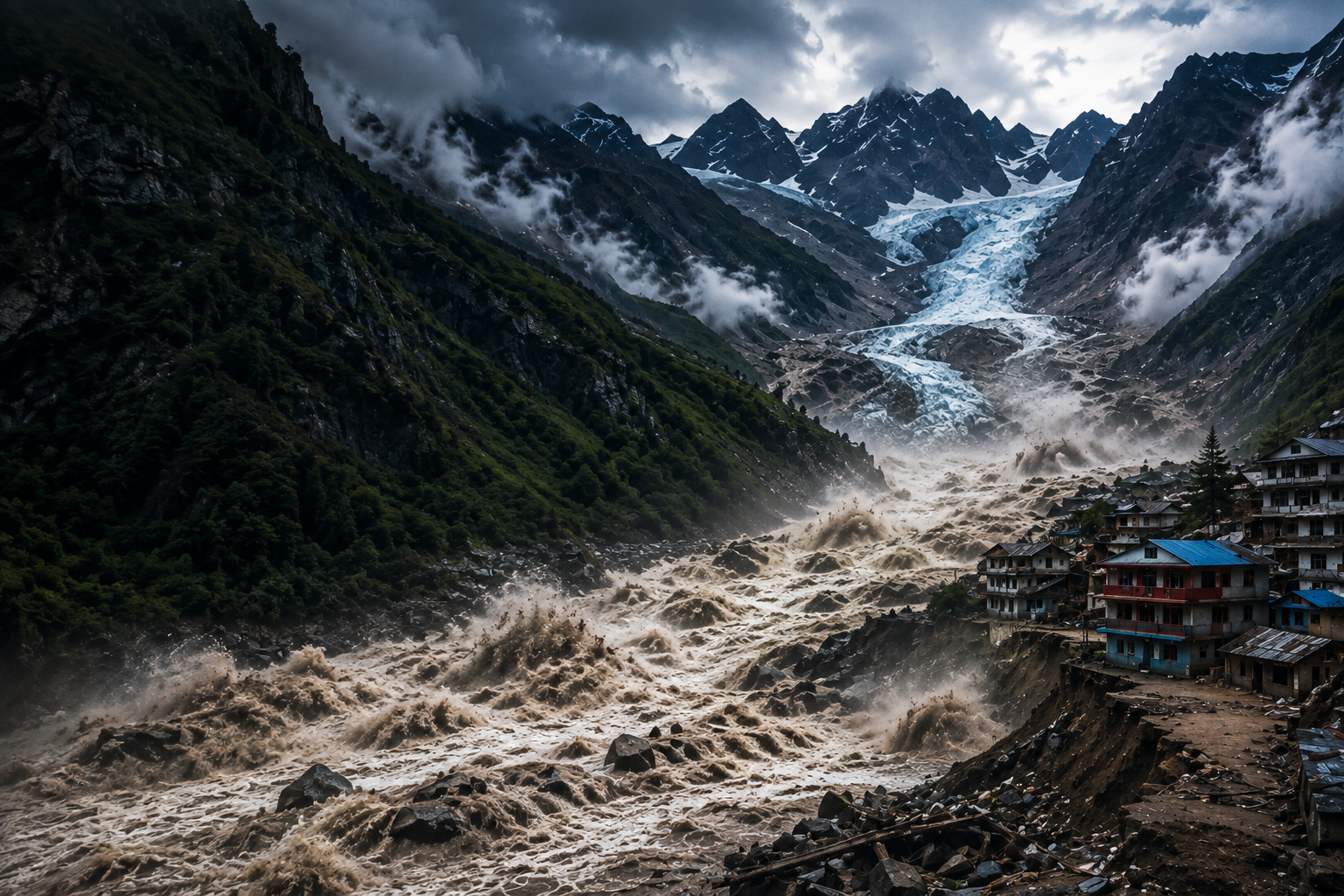
A disaster that started far above the ground
Some news stories feel distant until you realise how many lives are connected to them.
This week, a devastating flash flood struck communities near the Nepal–Tibet border after a major glacial collapse. The resulting surge of water, mud and debris swept through parts of the region with enormous force, leaving hundreds dead and many more missing.
Scientists investigating the disaster say a large section of glacier appears to have broken away and temporarily blocked a river. When that blockage gave way, an enormous volume of water rushed downstream.
Why this matters beyond Nepal
At first glance, this might look like another tragic natural disaster in a remote mountainous region. But the story is much bigger than that.
The Himalayas are home to some of the world's largest concentrations of glaciers, and millions of people across Asia depend on water systems connected to these mountains. When those systems become unstable, the consequences can reach communities far beyond the place where the original event happened.
Climate change does not always arrive as a slow, predictable process. Sometimes its risks appear through events that are sudden, difficult to predict and devastatingly fast.
The human side of the story
What makes this disaster especially heartbreaking is the number of people still unaccounted for.
Rescue teams are working across extremely difficult terrain while families wait for information about their loved ones. International organisations and governments have begun sending emergency supplies, medical assistance and rescue support.
India, China, the United States, the United Kingdom and several international organisations are among those providing or pledging assistance.
Technology can help — but it cannot stop the water
As developers, we often talk about technology in terms of products, artificial intelligence, cloud infrastructure and automation. But some of the most meaningful applications of technology are much simpler: helping people know when danger is coming.
Better satellite monitoring, glacier observation, river-level sensors, early-warning systems and reliable emergency communication can give communities something incredibly valuable during a disaster — time.
Even a few minutes of additional warning can make a difference when thousands of people are living downstream.
A reminder for all of us
Natural disasters cannot always be prevented. But the damage they cause can sometimes be reduced.
That requires scientists, governments, engineers and local communities working together. It also means treating climate data and early-warning infrastructure as essential public infrastructure rather than optional technology.
The tragedy unfolding in the Himalayas is ultimately about people, not numbers.
Behind every missing-person figure is a family waiting for an answer. Behind every destroyed building is someone's home or livelihood.
And behind this disaster is a larger question we cannot ignore:
How prepared are we for a world where environmental risks are becoming harder to predict?
Technology won't solve that problem alone. But used thoughtfully, it can help us see danger earlier, respond faster and protect more people.